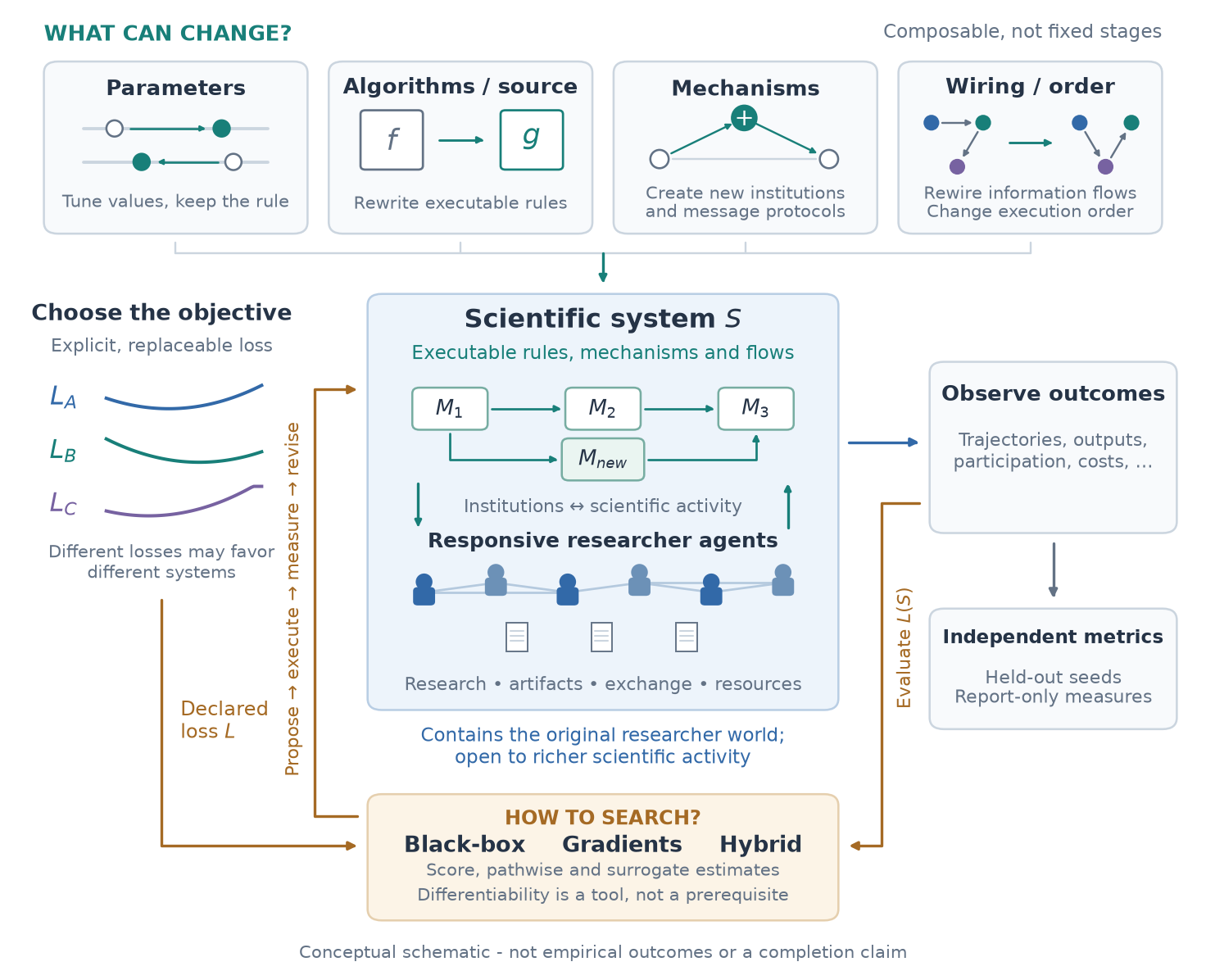
Parameters
Tune values while keeping the rule.
RESEARCHING THE SYSTEM AROUND SCIENCE
Not the researcher-model weights. The institutions around them. We make rules, mechanisms and information flows executable—and explore their consequences under explicit objectives.
RESEARCH SNAPSHOT · 17 NOV 2026 · EXPERIMENTS PAUSED
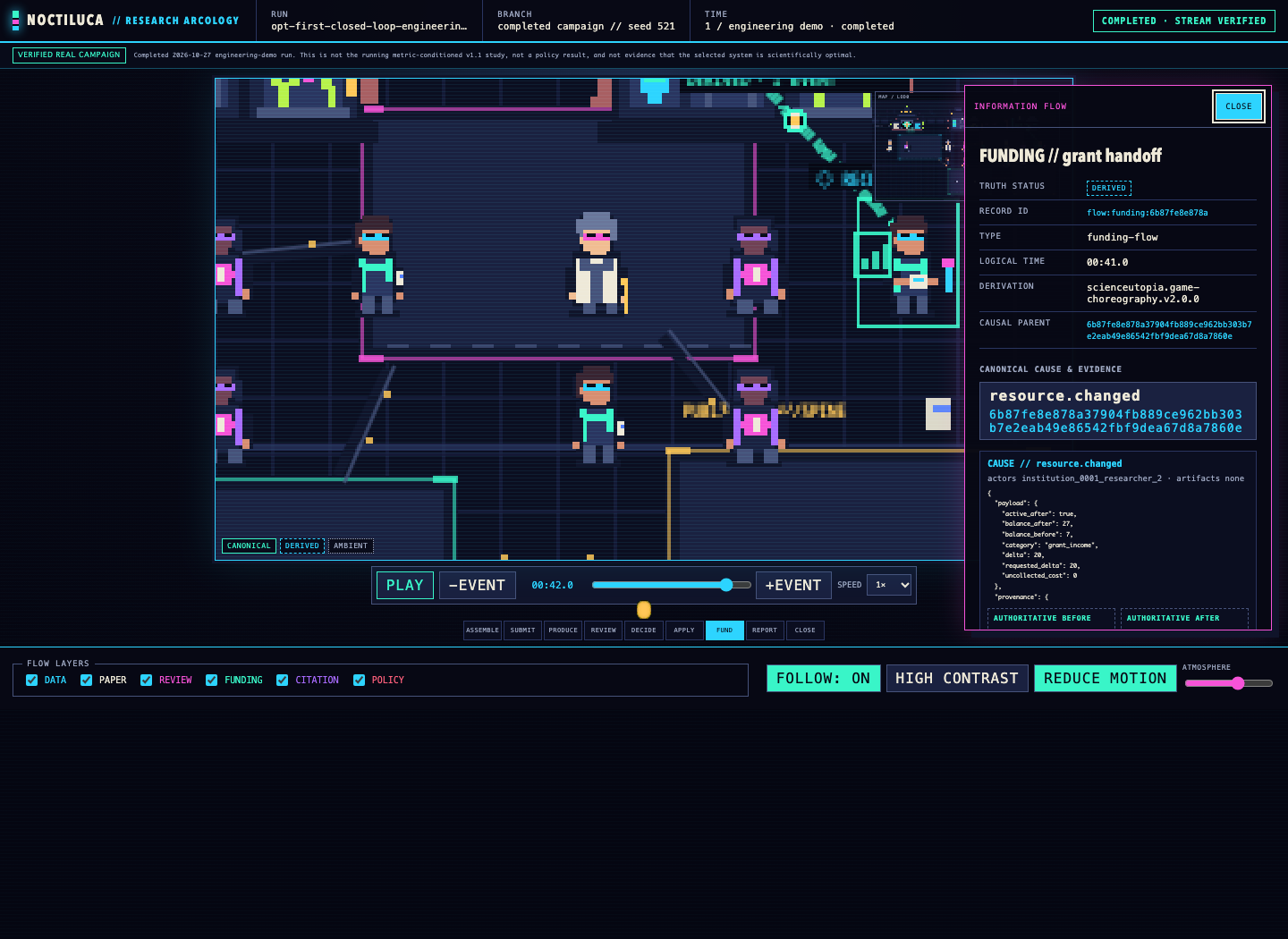
An implemented research platform, with an honest evidence boundary. Useful autonomous institutional invention and stable superiority to strong simple rules remain unestablished.
Where we stand ↗01 / THE RESEARCH QUESTION
What we ask science to achieve may change the institutions we should build. We turn that question into something we can execute, observe and optimize.
This research fork contains and extends the original ScienceUtopia researcher world. Peer review is one example—not the boundary. Evaluation, publication, funding, governance, and their connections and processes are design objects.
The optimization loss, technical execution validity, independent evaluation metrics, and optional adoption policy stay separate. Fairness or novelty requirements are not silently added to the objective.
Tune values while keeping the rule.
Rewrite executable code and decision rules.
Compose institutions beyond a fixed menu.
Change information flow, order and iteration.
02 / WHAT WE BUILT
Typed state, nodes, ports, wires, schedules and processes connect to the original lifecycle and real consumers. The authority boundary is explicit: naming a new node does not magically implement arbitrary native activities or treasury powers.
An LLM designer can edit code and configuration, probe components, submit a system and receive measured native-world losses. A source edit, an actual change in researcher inputs, and an objective improvement are three different observations.
Numeric and free code/graph search use measured ask/tell feedback. Finite budgets, strong references, execution nulls, frozen selections and audit trails are retained. An operational optimizer is not evidence that it invents a better institution.
Scoped tensor representations, relaxations and expectation-gradient estimators complement black-box evaluation. This is not universal autograd through arbitrary LLM calls and code, nor evidence of general live-world gradient superiority. Differentiability is a tool, not the research goal.
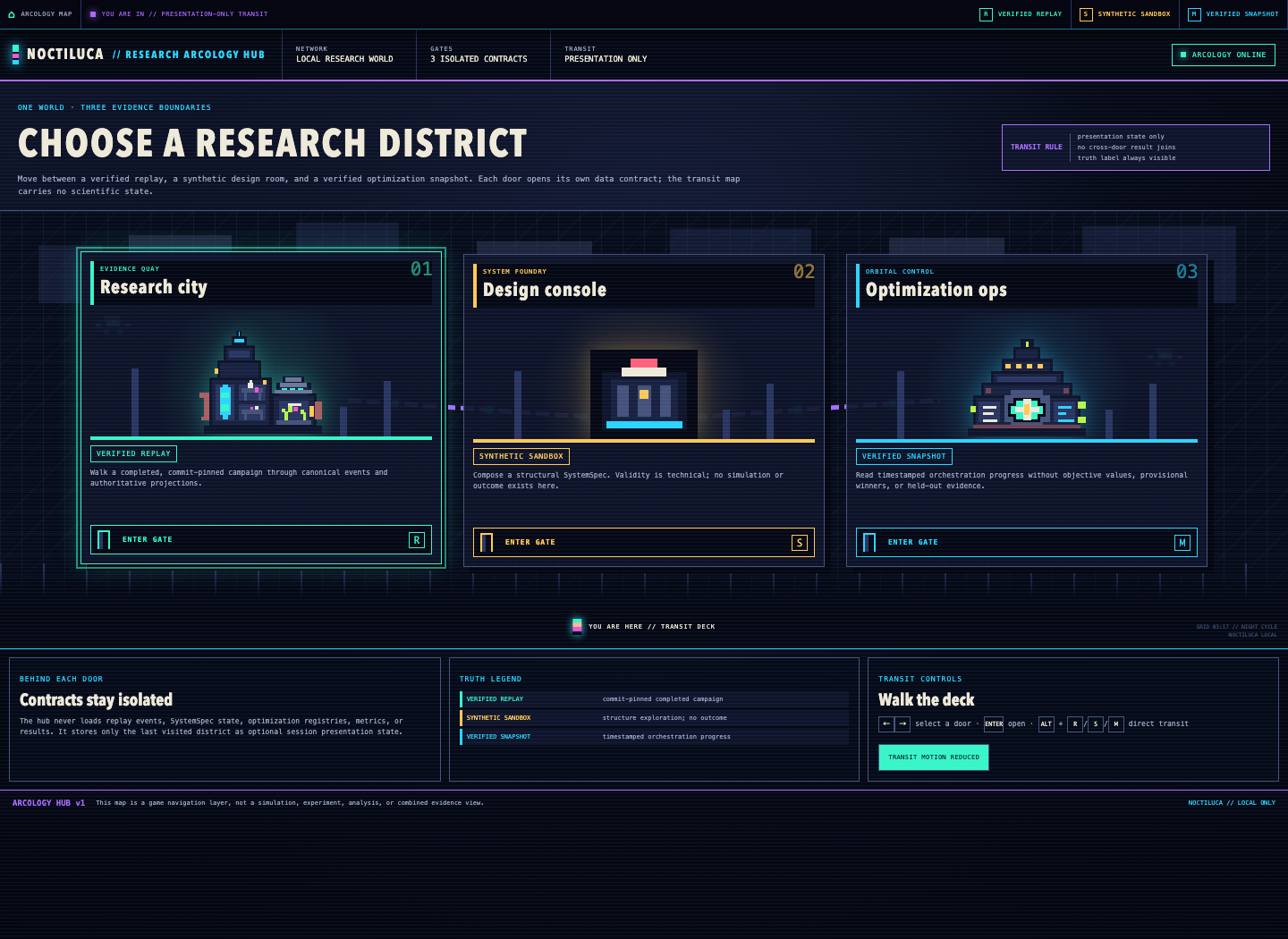
An English pixel/cyberpunk interface exposes events, institutional source, graphs and loss histories. Canonical evidence stays distinct from presentation-only choreography. It is a working replay/design/observation interface—not a finished management game.
03 / WHAT THE EXPERIMENTS SAY
The latest completed corrected search uses the original four-year world, five founding researchers and 103,107 literature records. Researcher models stay fixed at Qwen3-8B; three search methods target two explicit losses.
LOSS OF EACH SUBMITTED CANDIDATE
Lᵤ = −U · lower is better
One reused development condition; four proposals per method. Not independent optimizer replications or held-out evaluation. Points show submitted losses, not best-so-far incumbents.
Of eight free-design proposals, six complete candidates repeated a measured parent's full researcher-input path; one changed inputs and worsened utility; one failed execution. No wire or schedule edits were generated.
A separate hand-designed control improved the declared C loss by 4 while preserving utility: collected resources fell 200→160, unpaid costs rose 0→40, and requested expense stayed 200. This is neither automatic invention nor less requested work.
U is a sum of centered abstract-panel opinions, not scientific truth. K is collected native activity resources, not compute, money or real work.
Parameter, structure, workflow and gradient-estimator studies—including the earlier 120-slot design-freedom comparison and 90 physical selection-fixed evaluations—remain in the research index and integrated manuscript, with failures and limits. Different protocols are not pooled as independent replications.
Full research index ↗04 / NOCTILUCA
Researchers move. Manuscripts, reviews and resources circulate. A pixel/cyberpunk space becomes an interface for understanding execution records.
This is a historical interface recording, not live optimization progress or evidence of institutional superiority. Walking and interior choreography are presentation, distinct from recorded scientific activity.
This page is an exhibit. It makes no model calls and launches no experiments. The runnable interface and local setup instructions are in the repository.
05 / WHERE WE STAND
The new eight-slot information-feedback comparison was stopped at the user's request during reference execution, with zero own outcomes. It is not counted as a completed study. Creating this page does not resume it.
06 / READ, INSPECT, REBUILD
117 pages, 54 figures, 56 tables, 32 references. A broad research record—not a peer-reviewed paper or a submission-ready manuscript.
SOURCE CODE / GITHUBDesign, optimization, audits and UI. Cached manuscript reconstruction is distinct from independent fresh-inference reproduction.
RESEARCH RECORD / INDEXProtocols, closure records, analyses, known failures and limitations. The history stays inspectable.
INTERFACE / LOCAL SETUPRun the replay, design and evidence-viewing interface locally. Not a hosted experiment service.